
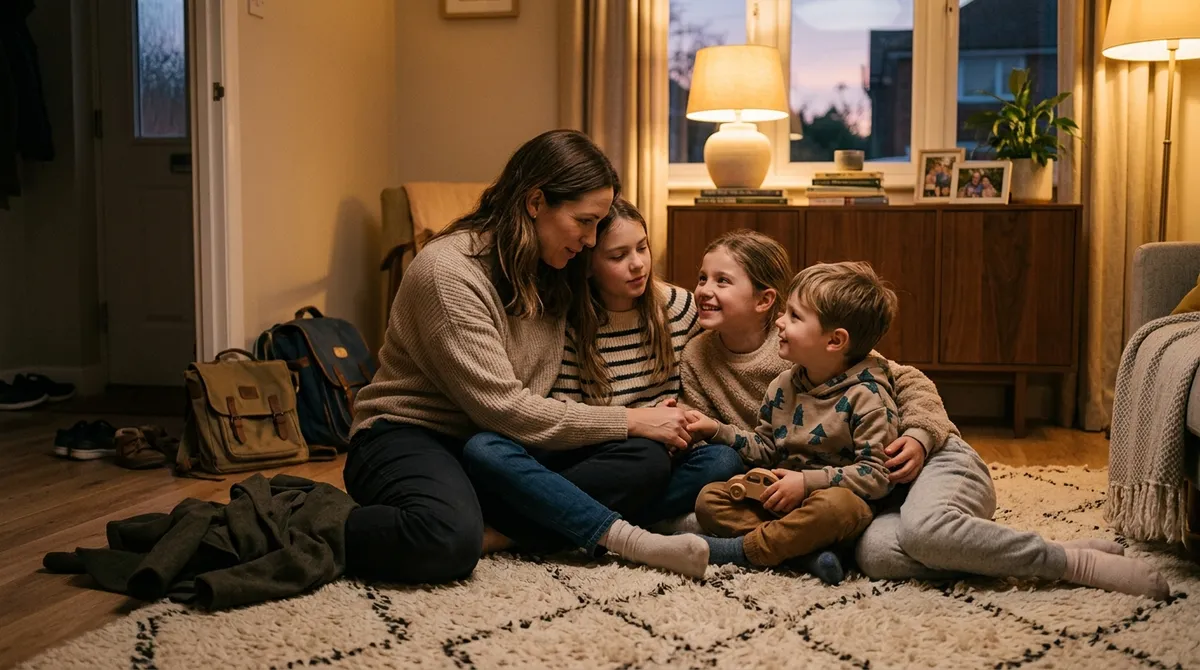
Most parents come home and immediately ask about homework, tests, or what happened at school — the performance stuff. Aravind Ramasokan, a father of three, does something different. Every evening, he carves out 15 minutes, hugs each of his children, and asks: "Were you happy today? What made you happy?"
That's it. No quiz about grades, no debrief on behavior. Just that one question.
According to reporting by Thebetterindia, Ramasokan's ritual is built on a simple belief: present parenting is less about grand gestures and more about consistent, small moments of genuine listening. If you've ever felt like the evening rush leaves no room for real connection, his approach is worth a closer look — and it's genuinely easy to copy.
Why the Question Matters More Than the Answer
When you ask a child about homework, you get a status report. When you ask what made them happy, you get a window into their inner world — who they're becoming, what they care about, what lit them up when no one was watching.
Children who are regularly asked about their emotional experience, rather than just their performance, learn two things quickly: their feelings are worth noticing, and their parent is a safe place to put them. That's the foundation of what child development researchers call emotional safety — the sense that you won't be judged or redirected when you share something true.
Ramasokan's question works precisely because it sidesteps the achievement frame. "Were you happy?" isn't asking a child to justify their day or defend their choices. It's an open door.
How to Try the 15-Minute Version Tonight
You don't need a perfect setup. You need 15 minutes and the willingness to actually listen — which means putting your phone face-down and not mentally drafting your reply while your kid is still talking.
Start with the hug. Ramasokan leads with physical connection before the question. That body-first approach matters: it signals safety before words even start. A genuine hug, or even a hand on the shoulder for older kids who've outgrown being squeezed, resets the emotional temperature after a long day apart.
Ask the question, then wait. "Were you happy today? What made you happy?" — and then let the silence sit. Kids often need a beat to actually think. If you jump in to fill the quiet, you'll get a shrug. If you wait, you'll frequently get something real.
Follow what they give you, not what you planned to ask. If your eight-year-old says the best part of their day was a weird bug they found at recess, that bug is now the conversation. The follow-up isn't "did you finish your reading?" — it's "what did it look like?" This is where connection actually happens.
End the 15 minutes on their terms. Don't pivot to logistics (dinner, baths, homework) mid-conversation. Let the ritual have a clean close. Kids remember whether you stayed or whether you rushed away.
What to Ask When "Happy" Doesn't Land
For some children — especially quieter kids, or kids going through a hard stretch — "were you happy today?" can feel like a loaded question if the answer is no. A few variations that open the same door without the pressure:
- "What was the best part of your day?" Even on a rough day, most kids can find one small thing.
- "Did anything surprise you today?" This one works well for kids who shut down when feelings are mentioned directly.
- "What's something you're thinking about right now?" Older children, especially in the 8–11 range, often respond better to curiosity questions than emotion questions.
- "Who did you spend time with today?" Relationships are often where the real stories live.
None of these are magic. What makes them work is the consistency — asking them every evening, not just when you sense something is wrong.
The Bigger Shift: Moving Away From Performance-Based Check-Ins
The culture around parenting can quietly nudge us toward treating our children's days like productivity reports. Marks, behavior charts, extracurricular progress — all of it is real and worth knowing. But if the only questions children hear at the end of the day are achievement-focused, they start to understand that's what earns your attention.
Ramasokan's ritual is a quiet corrective to that. By asking about happiness first — every single evening, as a non-negotiable — he's telling his three children something without saying it out loud: who you are matters more to me than what you did.
That message, repeated over thousands of evenings, is what builds the kind of relationship where a teenager actually talks to you. Not because you forced it, but because you trained them, from early on, that you were genuinely interested.
The One Thing That Makes This Work
Consistency. A single meaningful question asked every evening beats a deep heart-to-heart conversation once a month. Kids don't build trust through landmark moments — they build it through the accumulation of small ones.
You don't need to restructure your whole evening. You need 15 minutes, one question, and the discipline to actually listen to what comes back. Start tonight, and make it boring in the best way — the same question, the same hug, the same unhurried pause. That predictability is exactly what makes children feel safe enough to tell you something true.